


Medicaid Redetermination Assistance Software: The 2026 Provider’s Buying Guide
- FrontRunnerHC

- 1 day ago
- 11 min read
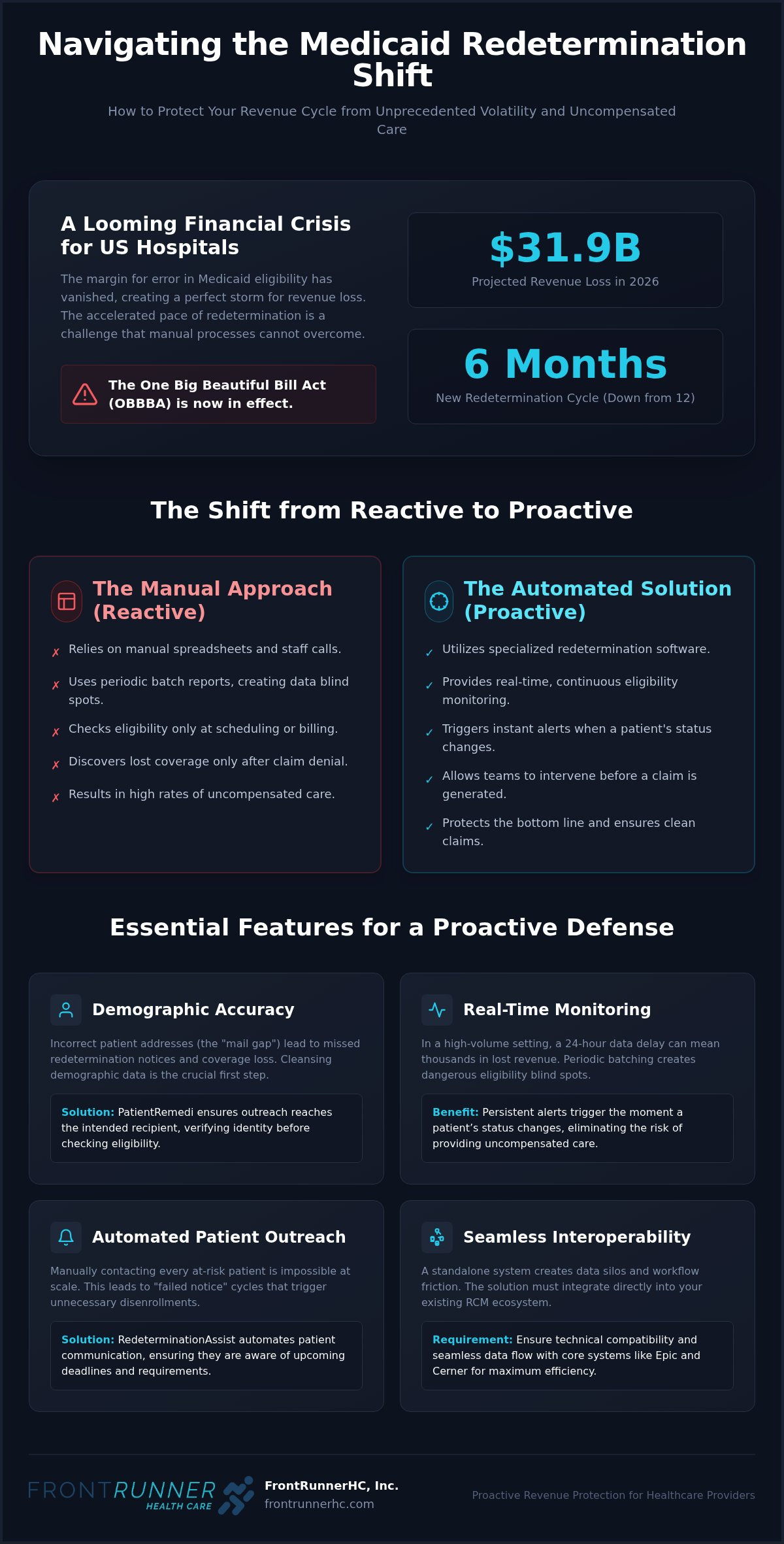
With US hospitals projected to face a $31.9 billion revenue loss in 2026, the margin for error in Medicaid eligibility has effectively vanished. The implementation of the One Big Beautiful Bill Act (OBBBA) means your staff is now grappling with redetermination cycles that have been slashed from twelve months to just six. It's a relentless pace that manual spreadsheets simply can't match. To survive this shift, forward-thinking organizations are prioritizing medicaid redetermination assistance software to stabilize their bottom line and protect their patient access.
You likely already feel the strain of eligibility churn as nationwide work requirements cause patient coverage to flicker on and off. It's exhausting to provide care only to discover the coverage was lost weeks ago due to a missed notice or an outdated address. This guide promises to show you how to automate Medicaid eligibility tracking, eliminate the sting of uncompensated care, and shield your revenue cycle from ongoing volatility. We'll preview the essential features of tools like RedeterminationAssist and PatientRemedi so you can replace manual outreach with high-speed, accurate automation that ensures your demographics are always current and your claims stay clean.
Table of Contents
What is Medicaid Redetermination Assistance Software?
For healthcare providers, medicaid redetermination assistance software is a specialized B2B technology designed to monitor patient eligibility statuses in real time. It's no longer enough to check coverage only at the time of scheduling. In the 2026 landscape, eligibility is volatile. This software acts as a proactive shield, identifying patients at risk of losing their Medicaid program benefits before they walk through your doors. While manual tracking relies on staff calling patients or checking portals one by one, automated solutions like RedeterminationAssist use direct data integrations to flag changes instantly. This shift from reactive billing to proactive verification is the only way to maintain a healthy revenue cycle.
The Role of RCM in Medicaid Unwinding
The transition from the pandemic-era Public Health Emergency (PHE) to the current "new normal" has introduced unprecedented administrative friction. In 2026, Medicaid Unwinding refers to the permanent, high-frequency cycle of eligibility reviews mandated by the One Big Beautiful Bill Act (OBBBA). This isn't a temporary phase. It's a fundamental change in how the Medicaid program operates. For hospitals and laboratories, the cost of uncompensated care is skyrocketing as patients lose coverage due to the new six-month redetermination cycles or monthly work requirements. Waiting for a claim denial is a costly mistake. By then, the service is rendered, the resources are spent, and the revenue is likely lost forever. Protecting the bottom line requires more than just checking a box. It requires accurate data. Tools like PatientRemedi ensure that the demographic information used for outreach is correct, preventing the "failed notice" cycle that triggers so many unnecessary disenrollments.
Key Terminology for Providers
Precision matters when discussing eligibility. While "renewal" and "recertification" are often used by patients, providers must focus on "redetermination," which is the legal process of verifying a member's ongoing eligibility. The era of continuous coverage is over. It's been replaced by "eligibility gaps" or "eligibility churn," where a patient might be covered on Monday but ineligible by Friday due to a failure to report 80 hours of monthly work. Successful RCM teams now prioritize real-time data over stale batch reports. If your data is forty-eight hours old, it's already a risk. Using medicaid redetermination assistance software ensures your staff works with current facts rather than outdated assumptions. This distinction between "static" and "dynamic" data is what separates a clean claim from a rejected one.
Core Features of Advanced Redetermination Software
Advanced medicaid redetermination assistance software transforms a reactive billing process into a strategic defense. High-performing platforms provide real-time verification across national databases, but the true value lies in continuous monitoring. Instead of a one-time snapshot, these systems offer persistent alerts that trigger the moment a patient’s status changes. This foresight allows your team to intervene before the claim is even generated. It moves the conversation from "why was this denied?" to "how do we keep this patient covered?"
The Foundation: Demographic Accuracy
Incorrect patient addresses are a silent killer of Medicaid revenue. It’s often referred to as the "mail gap." When a state sends a redetermination notice to an outdated address, the patient never sees it. The deadline passes, coverage drops, and your facility is left with an uncompensated care bill. PatientRemedi solves this by cleansing demographic data before the redetermination cycle begins. It ensures that every outreach attempt actually reaches the intended recipient. Clean data is the foundation of identity management. Without it, even the most sophisticated eligibility tools will fail because they’re tracking the wrong information. By verifying demographics first, you ensure the eligibility check is performed on a verified identity.
Real-Time Monitoring vs. Periodic Batching
In high-volume environments like labs or health systems, data ages quickly. Periodic batching might feel efficient, but it creates dangerous blind spots. Consider a scenario where a patient’s coverage is terminated on a Tuesday. If your batch report doesn't run until Wednesday night, every service provided in that 36-hour window is at risk of being uncompensated. A 24-hour delay in eligibility updates can result in thousands of dollars in lost revenue. Real-time alerts prevent these front-end errors by providing the most current status available. RedeterminationAssist automates this process, moving your staff away from manual portal checks and toward exception-based management.
If you want to see how these tools work together to protect your revenue, you can learn more about our integrated solutions.
Automated outreach is the final piece of the puzzle. When the software detects a pending redetermination date, it can trigger notifications to the patient or the billing team. This proactive communication ensures that paperwork is filed on time. It reduces the administrative burden on your staff while simultaneously increasing clean claim rates. It’s about building a workflow that prioritizes precision over guesswork. This level of automation is no longer a luxury; it’s a requirement for any provider operating in the 2026 Medicaid environment.
Buying Guide: How to Evaluate Medicaid Assistance Tools
Selecting the right medicaid redetermination assistance software requires looking beyond marketing promises to the technical architecture beneath. It's a strategic decision that affects every touchpoint of your revenue cycle. If a tool doesn't integrate seamlessly with Epic, Cerner, or your specific LIS, it creates a data silo that your staff will eventually ignore. Interoperability isn't a luxury; it's the bridge that allows eligibility data to flow into your billing system without manual entry. It ensures your team works within their existing workflows rather than jumping between disconnected platforms.
Scalability is equally vital. In high-volume environments, your software must handle 10,000+ batch runs without performance lag. If the system chokes during peak redetermination cycles, your front-end team is left flying blind. You should also demand transparency regarding accuracy rates. High "false positive" rates in insurance discovery lead to wasted administrative hours chasing non-existent coverage. Finally, evaluate the user interface. A dashboard that isn't instantly actionable for front-desk staff is a liability. It should highlight the "next best action" rather than burying users in raw data.
Feature Comparison Checklist
When comparing vendors, distinguish between essential eligibility checks and advanced capabilities. Basic tools tell you if a patient has coverage today. Advanced platforms provide Insurance Discovery to find hidden coverage and Financial Disposition insights to help segment self-pay populations. This segmentation allows your team to prioritize outreach to those most likely to regain coverage. Security is also non-negotiable in 2026. Ensure any partner meets current HIPAA and SOC2 Type II requirements to protect sensitive patient data against evolving threats. A secure, compliant foundation is the only way to scale with confidence.
Calculating ROI for Software Implementation
The financial case for automation is clear. By identifying coverage loss early, you reduce "bad debt" write-offs before they happen. Your staff gains efficiency by reclaiming hours previously spent on manual Medicaid portal logins, allowing them to focus on complex payer denials instead. For most organizations, a mere 5% increase in Medicaid retention through automated outreach generates enough recovered revenue to pay for the software entirely. It's about moving from a cost-center mindset to one of proactive revenue protection. When you eliminate the guesswork, the return on investment becomes a matter of simple math rather than hopeful speculation. To further support these initiatives, organizations can work with Dynamic Contracts Consultants LLC to secure the grants and funding necessary for large-scale technological implementations.
Implementing Redetermination Workflows in Your Organization
Installing medicaid redetermination assistance software is only half the battle. To truly protect your revenue, you must weave these tools into the daily rhythm of your revenue cycle. Success starts with a clear-eyed audit of your current Medicaid denial rates. You need to know why claims are failing. Is it a lack of patient outreach, or are you working with stale demographic data? Once you uncover these root causes, you can move toward a solution that addresses the actual friction points in your process.
Step 1: Audit denials. Identify the specific reasons for Medicaid coverage loss in your patient population.
Step 2: Cleanse the database. Use PatientRemedi to verify addresses and contact info, ensuring your outreach actually reaches the patient.
Step 3: Set up monitoring. Use RedeterminationAssist to flag high-risk patient segments before their renewal deadlines.
Step 4: Empower the front end. Train registration staff to use software alerts as a prompt for patient counseling.
Front-End vs. Back-End Strategies
Catching a redetermination issue at the point of registration is ten times cheaper than attempting back-end recovery after a denial. When your front-end staff receives an alert that a patient is in their renewal window, they can provide immediate counseling. This proactive approach helps the patient stay covered and ensures your facility gets paid. If Medicaid coverage has already lapsed, your team can pivot to Insurance Discovery to find alternative billable coverage, such as a secondary commercial plan or a change in primary status. It’s about having a backup plan for every scenario. It moves your team from a defensive posture to an offensive strategy.
Measuring Success: KPIs to Track
Data without measurement is just noise. To see the impact of your medicaid redetermination assistance software, you must track specific Key Performance Indicators. Focus on your clean claim rate for Medicaid payers; this should rise as eligibility errors decrease. Monitor the speed of self-pay to Medicaid conversions to ensure patients are re-enrolled quickly. Finally, track the percentage of at-risk patients who successfully maintain coverage through your outreach efforts. These metrics prove the value of your investment and highlight areas where your workflow might need further refinement. If you're ready to see these results in your own facility, it's time to optimize your Medicaid workflows with automated tools.
FrontRunnerHC, Inc.: Proactive Revenue Protection
In the volatile 2026 healthcare environment, guesswork is a financial liability. FrontRunnerHC, Inc. provides a data-first philosophy that transforms how providers manage the ongoing Medicaid unwinding. Our medicaid redetermination assistance software, specifically RedeterminationAssist, uncovers risk before it impacts your bank account. By combining the power of Insurance Discovery with real-time eligibility verification, we ensure no billable coverage goes unnoticed. It’s a strategic suite built to stabilize your revenue cycle. We advocate for the provider’s time and resources by replacing manual chaos with automated precision. This isn't just about software; it’s about building a resilient infrastructure that thrives despite market volatility.
Beyond Eligibility: The RedeterminationAssist Advantage
Most platforms stop at basic eligibility checks. RedeterminationAssist goes further by delivering automated outreach features that fill the gaps competitors often ignore. When you integrate this with PatientRemedi, you solve the demographic integrity problem at the source. Accurate addresses ensure that state notices actually reach the patient. This prevents the "mail gap" that leads to unnecessary disenrollment. Our national reach provides real-time accuracy across all state databases, ensuring your data is fresh. This synergy between identity management and coverage tracking is the definitive advantage in a landscape defined by rapid eligibility churn. It turns a broken manual process into a high-speed engine for revenue protection.
Getting Started with FrontRunnerHC, Inc.
The path to a cleaner revenue cycle is methodical and efficient. For mid-to-large healthcare organizations, the process begins with an initial batch run. This allows us to identify hidden coverage within your current self-pay or at-risk populations immediately. This data audit often uncovers billable revenue that was previously written off as bad debt. Our implementation timeline is built to respect your staff's time, focusing on seamless integration into your existing LIS or EHR. We handle the technical sophistication so your team can focus on patient counseling. Every potential friction point is considered and addressed before you go live. Stop reacting to the administrative burden of redetermination. Protect your revenue—request a RedeterminationAssist demo today.
Securing Your Revenue Against Medicaid Volatility
The 2026 regulatory landscape has permanently altered the Medicaid reimbursement model. Transitioning from manual outreach to a sophisticated medicaid redetermination assistance software isn't just an operational upgrade; it's a strategic necessity for survival. You've seen how demographic integrity through PatientRemedi serves as the bedrock for successful renewals. When you combine this with the national insurance discovery capabilities of RedeterminationAssist, you create a revenue cycle that is both resilient and proactive.
The administrative burden of the One Big Beautiful Bill Act (OBBBA) doesn't have to paralyze your billing staff. By automating tracking and outreach, you reclaim your team's time while protecting your bottom line from the risks of eligibility churn. It's time to replace the frustration of retroactive coverage loss with the clarity of real-time data. You have the tools to turn this industry chaos into a streamlined, predictable workflow.
Optimize your Medicaid workflows with RedeterminationAssist and ensure your organization remains financially sound in an era of constant change. You've built a better way forward.
Frequently Asked Questions
What is the primary benefit of Medicaid redetermination assistance software?
The primary benefit is the drastic reduction of uncompensated care by identifying coverage risks before services are rendered. This software automates the tracking of eligibility cycles, which prevents the revenue leakage associated with retroactive disenrollment. It allows your billing team to focus on high-priority claims rather than manual verification tasks. By stabilizing your revenue cycle, the software protects your bottom line from the volatility of the 2026 Medicaid landscape.
How does redetermination software differ from standard eligibility tools?
Standard eligibility tools typically provide a one-time snapshot of coverage at the point of service. In contrast, advanced medicaid redetermination assistance software offers continuous monitoring and real-time alerts for changes within your patient population. It tracks the entire redetermination window, whereas standard tools often miss the "eligibility churn" caused by monthly work requirements or shortened six-month renewal cycles. This persistent oversight is essential for maintaining accurate data in 2026.
Can this software help with patients who have already lost coverage?
Yes, the software helps by triggering Insurance Discovery workflows to uncover alternative billable coverage that the patient may not realize they have. If a patient is no longer eligible for Medicaid, the system can search for commercial plans or secondary payers to ensure the encounter remains reimbursable. This proactive search for alternative insurance prevents accounts from immediately defaulting to self-pay status, which significantly improves your chances of securing full payment.
Does Medicaid redetermination software integrate with my existing EHR?
Most enterprise-grade solutions integrate seamlessly with major EHR systems like Epic and Cerner through standard API or HL7 connections. This interoperability ensures that eligibility alerts and demographic updates flow directly into your existing billing workflows without requiring staff to log into separate portals. It reduces administrative friction and allows your front-desk teams to act on real-time data within the environment they already use for daily patient registration and scheduling.
How often should we run redetermination checks on our patient population?
In the 2026 environment, you should prioritize daily monitoring or real-time checks rather than weekly or monthly batches. The shift to six-month redetermination cycles and monthly work requirements means a patient's status can change overnight. Running frequent checks ensures you catch these transitions immediately. It allows your staff to counsel patients or verify alternative coverage before a service is performed, which is critical for maintaining high clean claim rates.
What happens if a patient is found to be ineligible for Medicaid?
When ineligibility is detected, the software triggers a Financial Disposition process to determine the next best financial step. This might include searching for alternative commercial insurance through Insurance Discovery, referring eligible patients to retirement health planning specialists like Medicare Mentors, or qualifying the patient for internal financial assistance programs. Instead of simply accepting the loss, your team can use the software's data to segment the patient and prioritize outreach. This structured approach ensures that every self-pay account is thoroughly vetted for potential reimbursement.
Automated outreach is fully compliant as long as the software partner adheres to HIPAA and SOC2 Type II security standards. These platforms are designed to protect sensitive patient data while facilitating necessary communication about coverage renewals. By using secure, encrypted channels for notifications, you can assist patients with their redetermination paperwork without compromising privacy. It's a reliable way to improve re-enrollment rates while maintaining a strict posture on federal data protection requirements.
How does demographic verification improve redetermination success?
Demographic verification through tools like PatientRemedi ensures that state-issued renewal notices actually reach the patient's current address. Many patients lose coverage simply because they never received their paperwork due to a "mail gap." By cleansing your database and verifying identities before the redetermination window opens, you eliminate the primary cause of procedural disenrollment. Accurate contact data is the foundation of any successful outreach strategy and is vital for protecting your facility's Medicaid revenue.


Comments