


Preventing Self-Pay Write-Offs: A Data-First Strategy for 2026
- FrontRunnerHC

- 1 day ago
- 11 min read
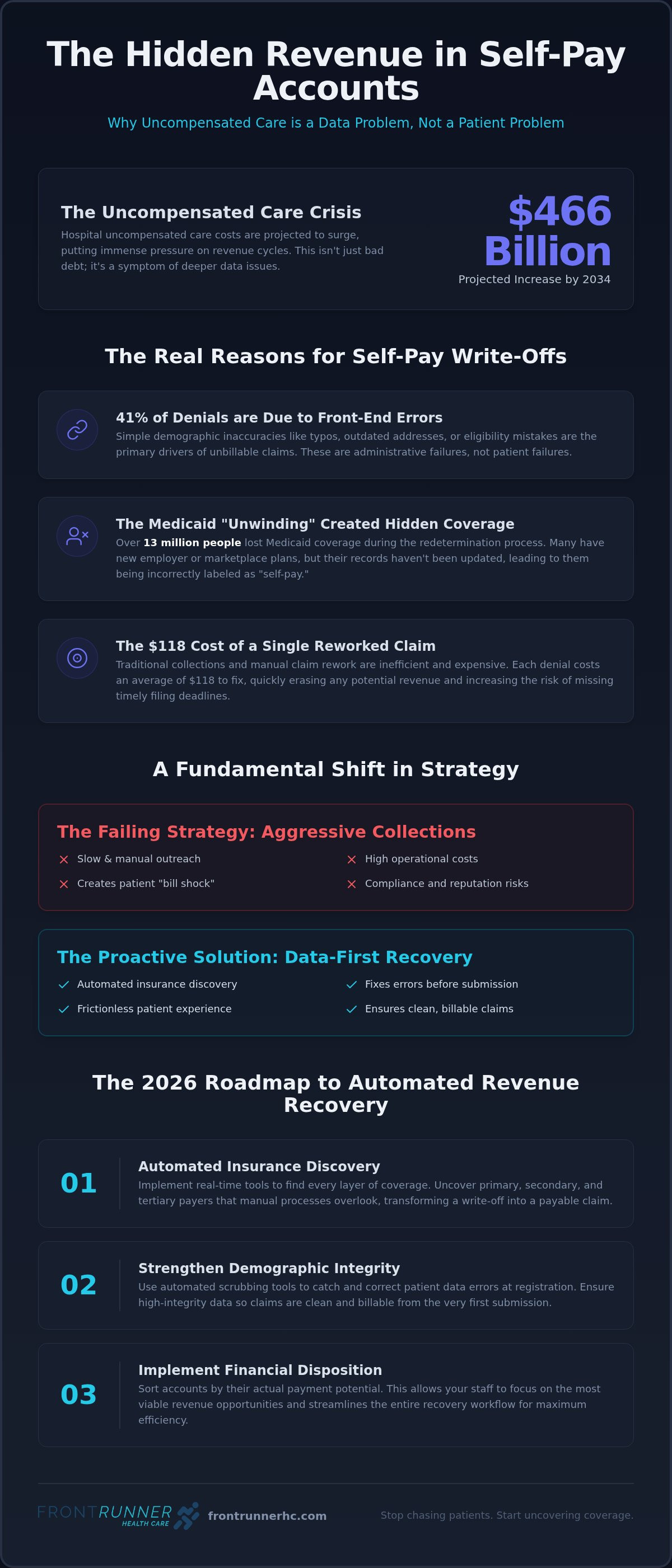
What if your largest source of bad debt isn't actually uncollectible? With hospital uncompensated care costs projected to increase by $466 billion between 2025 and 2034, the pressure on your revenue cycle has never been more intense. Successfully preventing self-pay write-offs in this environment starts with a fundamental shift in how we view the patient financial experience. It's a matter of data, not just dollars.
You're likely exhausted by manual demographic errors and the administrative weight of Medicaid redetermination. It's frustrating to watch unbillable claims pile up when you suspect coverage exists just beneath the surface. We understand the chaos of the modern billing office. This article will show you how to transform that uncompensated care into recovered revenue by prioritizing precision over persistence. We'll explore how to move away from the friction of aggressive collections and toward a proactive, data-first strategy. By focusing on uncovering hidden coverage through automated insurance discovery and maintaining demographic integrity, you can ensure your claims are clean before they ever leave the door.
Table of Contents
The State of Uncompensated Care and Self-Pay Write-Offs in 2026
In modern revenue cycle management, self-pay write-offs occur when a provider exhausts all billing attempts and removes the balance from their accounts receivable. It's a quiet, persistent drain on the bottom line. Historically, these were viewed as cases where patients simply couldn't or wouldn't pay. However, the reality in 2026 is fundamentally different. Most "self-pay" accounts are now the result of a data failure. They represent patients who actually have active coverage that the provider failed to identify at the point of service. Uncompensated care is defined as the sum of bad debt and charity care.
When revenue leaks through these write-offs, clinical quality inevitably suffers. Resources that should be dedicated to patient care are diverted to administrative cleanup and manual follow-up. Every dollar lost to an unbillable claim is a dollar not spent on medical technology, facility upgrades, or front-line staffing. Preventing self-pay write-offs is no longer just a financial objective; it's a strategy for sustaining the clinical mission. It requires moving away from the assumption of "no coverage" and toward a culture of data integrity.
The 2026 Medicaid Redetermination Crisis
The "unwinding" of continuous Medicaid enrollment has left a massive wake in the healthcare industry. Over 13 million people lost coverage during this transition, creating a massive volume of patients who are incorrectly labeled as self-pay. Many of these individuals have transitioned to employer-sponsored plans or ACA marketplace options but haven't updated their information. Without real-time tracking through tools like RedeterminationAssist, providers are left with stale data. Coverage gaps lead to an influx of unbillable claims. Identifying these shifts in real-time is the only way to stop the bleeding before an account reaches the write-off stage.
Why Traditional Collection Strategies Are Failing
Old-school collection methods are becoming a liability. Manual outreach is slow and incredibly expensive. Research shows it costs an average of $118 to rework a single denied claim, a price tag that quickly evaporates any potential profit. Patients in 2026 also have little patience for "bill shock," the frustration of receiving a massive invoice that their insurance should have covered. Regulatory pressure is also tightening. The No Surprises Act has introduced strict pre-collection compliance requirements that make many surprise balances non-collectible. Relying on aggressive collections isn't just inefficient; it's a risk to your organization's reputation and compliance standing.
Root Cause Analysis: Why "Self-Pay" is Often a Data Failure
Most providers categorize self-pay accounts based on what the patient provides at the front desk. This is a mistake. In reality, many patients are simply unaware they have active coverage, especially when they hold multiple policies or have recently transitioned between plans. This creates a "Hidden Insurance" problem that accounts for a significant portion of what hospitals eventually write off. Preventing self-pay write-offs requires distinguishing between true bad debt, where a patient truly lacks funds, and administrative bad debt, which is caused by simple clerical errors. When data is stale, the revenue cycle stops moving.
The cost of inaccurate data is staggering. Research indicates that 41% of all claim denials are attributed to front-end errors in registration and eligibility. These aren't just minor inconveniences; they are direct hits to your bottom line. Every time a claim is denied due to an error, it costs an average of $118 to rework it. By the time a billing team identifies the mistake, the timely filing window may have already closed, turning a billable service into a permanent loss.
The Impact of Incorrect Patient Demographics
The consequences of bad data are immediate. Typos in a name, outdated addresses, or transposed birthdates might seem minor, but they are the primary drivers of unbillable claims. Understanding the impact of incorrect patient demographics on billing is critical for any RCM team looking to stabilize their cash flow. Automated scrubbing tools like PatientRemedi catch these discrepancies before the claim is even generated, turning a potential write-off into a clean submission. This proactive approach clears the path for payment before the patient even leaves the facility.
The Limitations of Manual Eligibility Checks
Checking an insurance card at the window isn't enough. Manual checks often miss the nuances of secondary and tertiary coverage layers that could cover the balance. For high-volume diagnostic labs, maintaining data integrity is a constant battle because they often receive information from external sources that may be weeks or months out of date. Real-time verification is the only way to catch these shifts. While some patients truly need Hospital Charity Care, many others are simply victims of a broken data flow. Focusing on preventing self-pay write-offs through automated discovery ensures you aren't leaving money on the table due to administrative friction. Implementing a robust Insurance Discovery process can turn these data failures into revenue opportunities.
Strategy 1: Proactive Insurance Discovery and Real-Time Eligibility
The most effective way to protect your bottom line is to stop a write-off before it happens. Traditional revenue cycle models often treat insurance discovery as a last-ditch effort after a claim is rejected. This reactive stance is expensive and inefficient. By moving discovery to the very front of the patient encounter, you shift the focus from debt collection to revenue recovery. This proactive approach is the cornerstone of preventing self-pay write-offs. It involves scanning for primary, secondary, and even tertiary coverage layers that the patient might not even know they have.
Automated systems don't just look for active plans; they dig deeper. They identify Medicare Supplement plans, COBRA coverage, and workers' compensation details that manual checks often miss. For patients who appear uninsured at the time of service, providers must leverage retroactive insurance discovery software. This technology identifies coverage that was backdated, ensuring that services provided during a temporary gap remain billable. This is a vital component in managing the broader challenge of uncompensated care, where identifying any payer source is a win for the organization. Success in preventing self-pay write-offs depends on this level of granular visibility.
Real-Time vs. Batch Discovery Workflows
Real-time verification is your first line of defense. It provides immediate financial clearance during registration, allowing staff to address coverage issues while the patient is still on-site. It's fast; it's accurate; it's essential for point-of-service collections. In contrast, batch discovery is equally powerful for clearing an existing A/R backlog. It allows high-volume specialty clinics and diagnostic centers to scrub thousands of accounts simultaneously. This dual-layered approach ensures that no billable account slips through the cracks, regardless of when the data was first captured.
Managing Medicaid Continuity with RedeterminationAssist
The 2026 landscape is defined by the ongoing impact of Medicaid redetermination. Patients often "churn" in and out of eligibility, leading to sudden, unexpected self-pay balances. RedeterminationAssist automates the monitoring of these status changes. It alerts your team the moment a patient loses Medicaid coverage, allowing you to transition them to Marketplace plans or commercial options immediately. This prevents the account from ever reaching a state of delinquency. Instead of writing off the balance, you're guiding the patient toward a sustainable payment path that preserves your revenue.
Strategy 2: Strengthening Demographic Integrity and Financial Disposition
Clean data is the bedrock of a healthy revenue cycle. When patient records are incomplete, inaccurate, or outdated, the entire billing process stalls before it even begins. Demographic verification isn't just about getting a street address right; it's about establishing a verifiable, billable identity for every individual who walks through your doors. By using data enrichment, providers can automatically fill in missing gaps like social security numbers, employer details, or updated contact information. This significantly reduces the administrative burden and high cost of returned mail, which is a silent driver of uncompensated care. When you can't reach the patient, you can't resolve the balance.
Implementing PatientRemedi for Data Remediation
Implementing healthcare data remediation software like PatientRemedi allows organizations to fix broken records in real-time. This creates a powerful synergy between demographic accuracy and first-pass claim acceptance. Instead of billing staff spending hours manually correcting typos or verifying old phone numbers, the system handles the heavy lifting through automated scrubbing. This automation is a critical step in preventing self-pay write-offs because it ensures the claim reaches the right payer with the correct information the first time. Fewer manual touches mean faster payments and a lower cost to collect.
Financial Disposition: A Strategic Approach to Recovery
Once the data is clean, the next step is Financial Disposition. This involves sorting accounts by the patient's actual ability to pay or their likelihood of having hidden coverage. It's a strategic move away from treating all self-pay accounts as a single, monolithic block of debt. By segmenting patients, you can identify who has high insurance potential versus who truly qualifies for charity care. This ensures your RCM resources are focused exclusively on accounts with the highest recovery potential, rather than wasting time on uncollectible balances.
Identifying true self-pay patients early allows for proactive financial counseling. For those who are actually eligible for coverage, automated discovery finds the revenue. For those who aren't, you can move them toward financial assistance programs or charity care immediately. This clarity protects your staff from chasing "ghost" revenue and streamlines the path to preventing self-pay write-offs. You can start optimizing your recovery strategy today with Financial Disposition tools that prioritize precision over guesswork.
The 2026 Roadmap to Automated Revenue Recovery
Begin your journey by auditing your existing bad debt. You'll likely discover that a significant portion of those balances isn't a result of a patient's inability to pay, but rather a failure to identify active coverage. This audit serves as the essential baseline for preventing self-pay write-offs. By integrating automated discovery into both the registration and billing stages, you create a continuous loop of verification that catches errors before they crystallize into permanent losses. High-volume environments require a specialized approach to remain efficient. Leveraging RCM automation for specialty clinics allows your team to maintain data integrity without slowing down the pace of care.
A/R Clean-Up: Recovering Revenue from the Backlog
Your existing backlog is often a goldmine of hidden reimbursement. Using automated software to scan old uncompensated accounts can reveal coverage that was active at the time of service but missed during the initial intake. This process is about reimbursement optimization, not debt collection. It's a method of finding the right payer rather than chasing the patient. Prioritize these older accounts based on their financial disposition. By focusing on accounts with high insurance potential first, you accelerate cash flow and clear out the "administrative noise" that clogs your revenue cycle. It's an efficient way to turn yesterday's losses into today's liquidity.
Building a Sustainable, Data-First RCM Culture
Technology is only half the battle; the other half is culture. Train your front-end staff to understand that data integrity at registration is the most powerful tool for preventing self-pay write-offs. When they see the direct link between a typo and an unbillable claim, accuracy becomes a priority rather than a chore. Measure your progress through clear, outcome-focused metrics. Track your Clean Claim Rates and "Insurance Found" percentages to visualize the impact of your new strategy.
Positioning FrontRunnerHC as your strategic partner allows you to move beyond manual guesswork. We provide the tools to monitor and remediate patient data continuously, ensuring that your revenue cycle remains resilient against industry shifts like Medicaid redetermination. This proactive stance transforms the billing office from a cost center into a value driver. By valuing precision over persistence, you protect your provider's resources and ensure that every service rendered is a service paid.
Turning Data Failures into Revenue Success
The path to financial stability in 2026 requires a move away from the reactive habits of the past. You've seen how self-pay is frequently a misnomer for missing or inaccurate data. By prioritizing demographic integrity and real-time verification, you can reclaim revenue that would otherwise be lost to the bad debt pile. Successfully preventing self-pay write-offs isn't about working harder; it's about working smarter with the right technology at your side to uncover coverage that already exists.
FrontRunnerHC, Inc. stands as your strategic partner in this transition. With PatientRemedi for advanced demographic verification and RedeterminationAssist for automated Medicaid tracking, you can maintain a clean, billable patient index. Our Insurance Discovery tools provide the real-time coverage identification needed to ensure every service is matched with a valid payer. It's time to stop the cycle of uncompensated care and start building a more resilient, data-first organization.
Discover how FrontRunnerHC, Inc. can reduce your uncompensated care costs today. You have the power to transform your revenue cycle, and we're here to help you every step of the way.
Frequently Asked Questions
What is the difference between bad debt and charity care?
Bad debt represents the portion of billable services where a patient has the potential to pay but the provider is unable to collect the balance. In contrast, charity care involves services provided to patients who meet specific financial assistance criteria and are not expected to pay. Both categories contribute to uncompensated care totals. Distinguishing between them is vital for financial reporting and for accurately preventing self-pay write-offs through better data segmentation.
How does insurance discovery software reduce self-pay write-offs?
Insurance discovery software reduces write-offs by scanning thousands of data points to uncover active primary, secondary, or tertiary coverage that a patient may have missed. Many patients are unaware of their eligibility for certain plans or have recently transitioned to new employer-sponsored insurance. By finding these billable payers before the account is sent to collections, providers can secure reimbursement that would otherwise be lost to administrative bad debt.
Can automated demographic verification really lower claim denials?
Yes, automated demographic verification significantly lowers denials by correcting front-end errors such as misspelled names, outdated addresses, or transposed birthdates before claim submission. Tools like PatientRemedi scrub patient records in real-time to ensure data integrity. By fixing these discrepancies early, organizations ensure a higher clean claim rate and prevent the costly administrative burden of reworking unbillable claims. This proactive approach clears the path for payment before the billing cycle even begins.
How is Medicaid redetermination affecting hospital revenue in 2026?
Medicaid redetermination is creating a massive influx of uncompensated care as millions of patients lose continuous enrollment coverage. This often results in patients being incorrectly labeled as self-pay when they may actually be eligible for Marketplace plans or other commercial options. RedeterminationAssist helps hospitals track these status changes in real-time. This allows providers to intervene early and transition patients to appropriate coverage, protecting revenue from sudden and unexpected eligibility gaps.
What are the most common uncompensated care reduction strategies?
Common strategies include implementing real-time insurance discovery, automating demographic verification, and performing retroactive coverage searches on an A/R backlog. Leading organizations also focus on financial disposition to segment accounts by their actual recovery potential. By shifting the focus from manual patient collections to high-tech data remediation, providers can identify billable insurance sources early in the revenue cycle and stop revenue leakage before it impacts the bottom line.
How does financial disposition help with patient debt management?
Financial disposition helps by segmenting patient accounts based on their actual likelihood of payment or potential for hidden insurance coverage. Instead of treating every self-pay balance the same, this strategy allows RCM teams to prioritize accounts with high recovery potential. It distinguishes between patients who need financial assistance and those who have billable insurance. This clarity ensures that staff resources are used efficiently, focusing on accounts that can be resolved through reimbursement.
Is it possible to find insurance for patients who claim to be self-pay?
It is very possible to find insurance for patients who identify as self-pay. Patients frequently provide outdated information or are unaware that they have active secondary or retroactive coverage. Using automated tools to perform a deep scan of payer databases often reveals billable policies that were missed during initial registration. This is a critical tactic for preventing self-pay write-offs by identifying legitimate payers for accounts previously deemed uncollectible.
What is the cost-benefit of RCM automation for bad debt reduction?
The cost-benefit is substantial when you consider the high expense of reworking denied claims. Automation reduces this burden by ensuring every submission is clean and billable from the start. By replacing slow, manual eligibility checks with real-time verification and automated insurance discovery, healthcare organizations achieve a positive return on investment. This shift leads to higher clean claim rates and a significant reduction in the volume of accounts relegated to bad debt.


Comments