


The Definitive Guide to Healthcare Data Remediation Software in 2026
- FrontRunnerHC

- 1 day ago
- 11 min read
Updated: 8 hours ago
What if your highest claim denial rate wasn't a billing problem, but a data integrity crisis? For years, providers have treated fragmented patient records like an unavoidable cost of doing business. It's time to reframe that perspective. Implementing high-performance healthcare data remediation software isn't just a technical upgrade; it's the active cure for the chronic illness of broken information that drains your revenue.
You've likely spent countless hours on manual, labor-intensive billing cleanup only to find that demographic errors still trigger denials. It's frustrating to watch uncompensated care climb because of inaccurate insurance eligibility information. We understand the administrative weight you carry. This guide will show you how to transform those fragmented records into clean, reimbursable data through automated remediation strategies. We'll explore how tools like PatientRemedi and RedeterminationAssist automate insurance discovery workflows, ensuring your team spends less time chasing data and more time securing the revenue your facility earned. By the end of this article, you'll have a clear roadmap to higher clean claim rates and a more resilient bottom line.
Table of Contents
What is Healthcare Data Remediation Software?
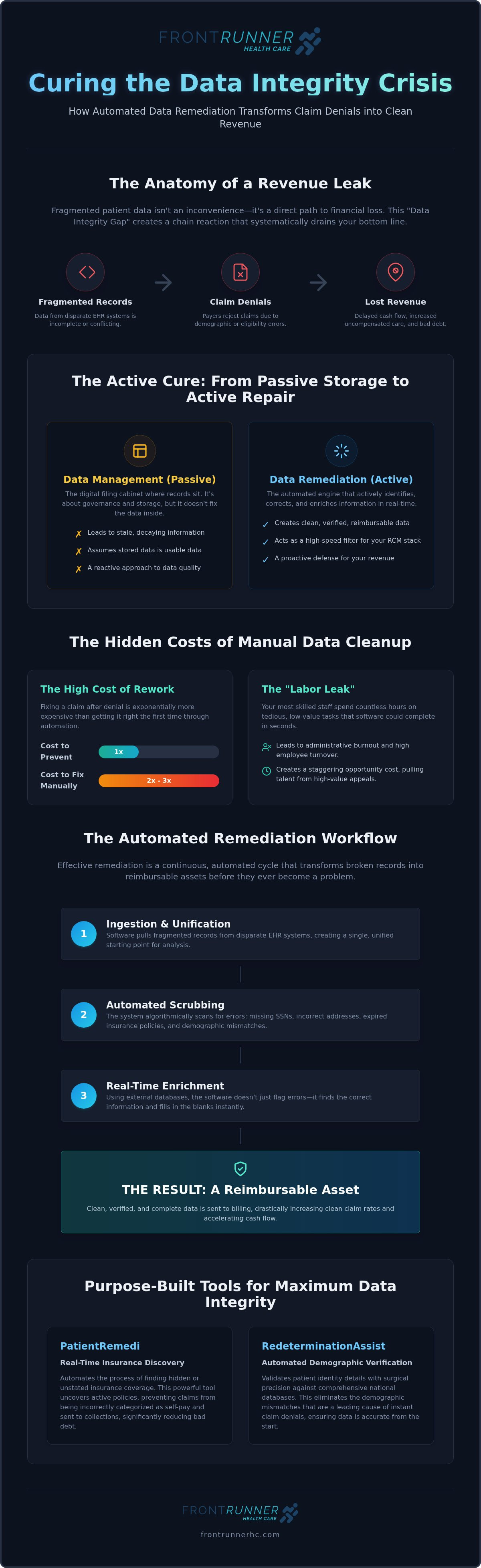
It's a common mistake in the industry. Many providers assume that if patient data is stored in their system, it's usable. They confuse data management with data remediation. Management is about governance and storage; it's the digital filing cabinet where records sit. Remediation is the active, automated engine that identifies, corrects, and enriches that information. Think of it as the difference between owning a library and having a librarian who constantly updates every book's facts in real-time. Implementing healthcare data remediation software is the first step toward moving from a passive data strategy to an active revenue defense.
This technology addresses the "Data Integrity Gap." This is the dangerous space where stale information leads to financial friction. Every time a patient moves, changes jobs, or switches insurance providers, their record begins to decay. When you rely on this "stale" data, the result is a denial. Modern data quality standards require more than just a place to keep files. They demand a system that actively repairs errors before they reach the payer. In the modern Revenue Cycle Management (RCM) stack, remediation acts as a high-speed filter, ensuring only clean, verified data moves forward to billing.
The Anatomy of a Data Remediation Workflow
Effective remediation isn't a single event. It's a continuous cycle that starts with data ingestion. The software pulls fragmented records from disparate EHR systems, creating a unified starting point. Next comes automated scrubbing. The system scans for missing Social Security numbers, incorrect addresses, or expired insurance policies. Finally, real-time enrichment uses external databases to fill in the blanks instantly. It doesn't just tell you a phone number is wrong; it finds the right one. This workflow transforms a broken record into a reimbursable asset without requiring a single minute of manual labor from your staff.
Why 2026 is the Year of Data Accuracy
Every denied claim represents a puncture in your revenue cycle. It's not just the lost reimbursement; it's the labor hours spent on rework and the inevitable delay in cash flow. When you rely on broken information, you're essentially gambling with your bottom line. High-performance healthcare data remediation software acts as a sealant, closing those gaps before the leakage becomes a flood. Industry leaders recognize that the cost of fixing a claim after it's been denied is often double or triple the cost of getting it right the first time.
The root causes are often predictable. Eligibility errors, demographic mismatches, and missing authorizations account for a massive percentage of data-driven denials. Without a robust data governance framework, these errors become systemic. Stale data quickly transforms into uncompensated care and bad debt write-offs that could've been avoided with better front-end verification. By implementing a strategy focused on Financial Disposition, your team can prioritize high-value recovery opportunities instead of chasing every minor error with the same level of intensity.
The Hidden Costs of Manual Data Cleanup
Manual cleanup is a silent profit killer. We call it the "Labor Leak." Think about the time your staff spends calling patients just to verify an address or a middle initial. It's tedious, repetitive work that leads to administrative burnout and high turnover among your most experienced employees. When your best billing talent is stuck doing manual data entry, the opportunity cost is staggering. They should be focused on complex appeals and strategic revenue planning, not hunting for missing insurance details that healthcare data remediation software could find in seconds.
Medicaid Redetermination: A Growing Crisis for Providers
The Medicaid "unwinding" has created a volatile environment for reimbursement. Sudden coverage gaps lead to spikes in self-pay accounts, often catching both patients and providers off guard. This is where tools like RedeterminationAssist become essential. By monitoring coverage changes in real-time, you can prevent surprises at the point of care and use automated outreach to help maintain patient enrollment. It's a proactive way to ensure your facility gets paid for the services it provides while helping patients navigate their coverage transitions. If you're ready to stop the drain on your resources, it's time to optimize your data integrity with smarter automation.
Key Features of Advanced Remediation Platforms
Moving from the financial impact to the technical solution requires a look at the specific capabilities that drive results. Advanced healthcare data remediation software isn't a passive tool. It's an active participant in your revenue cycle. It performs the heavy lifting that previously required dozens of man-hours. By focusing on automation, these platforms eliminate the guesswork that often leads to rejected claims and delayed payments. It's about precision, not just speed.
Real-time Insurance Discovery: This feature uncovers active primary and secondary coverage with minimal patient input, often using just a name and date of birth.
Automated Demographic Verification: The system cross-references patient details against credit and postal databases to ensure every address and phone number is current.
Advanced Eligibility Verification: It goes beyond a simple "yes/no" response to provide detailed benefit breakdowns, including deductibles and co-insurance.
A/R Cleanup Tools: These tools scan aged accounts to identify collectible revenue that was previously missed, allowing you to clear backlogs without hiring more staff.
Insurance Discovery vs. Eligibility Verification
The distinction between these two functions is critical, yet many teams use the terms interchangeably. Discovery finds the policy. Eligibility confirms it. You need both to be truly effective. For high-cost diagnostic testing or specialty procedures, finding "hidden" secondary insurance is the difference between a paid claim and a total write-off. PatientRemedi integrates these two functions into a single, seamless workflow. It eliminates the need for your staff to toggle between different portals or manually call payers. It's a strategic way to ensure that no coverage remains untapped, protecting both the provider's revenue and the patient's financial experience.
Patient Demographic Scrubbing
Clean demographics are the foundation of a healthy administrative system. Scrubbing involves more than just checking a zip code; it’s the technical process of normalizing addresses to postal standards and verifying identities in real-time. This reduces the volume of "return to sender" mailings and significantly improves patient portal adoption rates. If the data is wrong, the patient never receives the invite. Beyond the mail, this process is vital for Enhancing Semantic Integrity in Health Data. It ensures compliance with identity management standards and prevents the nightmare of medical record overlays. When you use healthcare data remediation software to maintain this integrity, you're protecting the clinical record just as much as the financial one.
Implementing Data Remediation: A Strategic Framework
Implementation isn't a reaction to failure. It's a strategic integration into your existing revenue cycle. To begin, you must audit your current state. Pinpoint exactly where the most frequent data failures occur. Is the friction happening at the front desk, or is it a downstream issue in billing? Once you've identified the leaks, determine your integration strategy. High-quality healthcare data remediation software should sit alongside or directly inside your EHR, whether you're using Epic, Cerner, or another platform. To ensure your broader technical environment is ready for such tools, MEDITIL provides tailored IT solutions specifically designed for the healthcare sector. This ensures a seamless flow of information without forcing your staff to learn a completely new interface.
Don't try to fix every department at once. Use a phased rollout. Start with high-volume, high-friction areas like the Emergency Department or the Lab. These are the front lines of data decay where speed often trumps accuracy. As you expand the system, measure your success through specific KPIs. Monitor your Clean Claim Rate (CCR) and Days Sales Outstanding (DSO). These metrics provide the concrete proof that automated remediation is working. They transform your data strategy from a cost center into a documented revenue driver.
Fixing data at registration is 10x cheaper than fixing it after a denial. It's a simple truth that many organizations ignore until the denial rates become unsustainable. Empower your front-desk staff with real-time alerts and automated corrections. When the system flags an error, they can resolve it instantly while the patient is still present. This shifts your culture from manual entry to automated verification. Training your team to trust these automated tools over manual methods is a leadership challenge, but the results are undeniable. It reduces the administrative weight on your staff and ensures the record is clean before it ever leaves the building.
Clearing the Backlog: Retroactive Remediation
What about the revenue already trapped in your backlog? Use Accounts Receivable Clean-Up tools to uncover "lost" revenue in accounts older than 90 days. By enriching old records with current insurance info, you can resubmit previously denied claims that were once considered uncollectible. The ROI of automated data enrichment for historical billing cycles is often immediate. It turns stale, forgotten records into fresh cash flow without the need for manual research. If you're ready to stop the leakage and start recovering what you've earned, schedule a demo of our automated remediation solutions today.
FrontRunnerHC: Accelerating Reimbursement Through Data Integrity
FrontRunnerHC doesn't just provide technology; we provide a path out of administrative chaos. We understand that administrative friction isn't just a nuisance. It's a barrier to providing care. We've built our suite of tools to dismantle that barrier. PatientRemedi stands as the definitive healthcare data remediation software for organizations that can't afford to let fragmented records dictate their financial health. It doesn't just flag errors; it repairs them. This proactive approach ensures demographic and insurance integrity before a claim ever leaves your system.
The Medicaid coverage crisis requires more than just awareness. It demands action. RedeterminationAssist was designed specifically to tackle the complexities of the unwinding by monitoring coverage changes in real-time. This protects your reimbursement while ensuring patients don't lose access to care due to simple paperwork errors. We take a no-nonsense approach to revenue. We find the money you've already earned without ever calling a patient for debt. We built our healthcare data remediation software to act as a defender of your resources, ensuring that every patient interaction is backed by verified, actionable information.
Why PatientRemedi is Different
Most systems offer high-level analytics that merely tell you what's wrong. They give you a report and leave the actual fixing to your staff. PatientRemedi is different. Our proprietary logic uncovers coverage that other systems miss. It's built for boots-on-the-ground utility. We focus on the individual claim because that's where the revenue lives. By focusing on the specific details of every record, we provide the practical utility your billing team needs to stay efficient. Our seamless integration reduces administrative chaos and restores order to your front-end processes. It's not about benchmarking the problem. It's about solving it.
Take the Next Step Toward Data Clarity
You don't have to guess about the health of your data. We provide a baseline assessment to identify exactly where your integrity is failing and where revenue is leaking. Transitioning from manual, labor-intensive processes to automated remediation is simpler than you think. Our team acts as a strategic partner, guiding you through every step of the integration. We ensure your EHR is enriched with the most accurate data available, allowing your team to focus on patients rather than paperwork. Stop chasing broken records and start accelerating your reimbursement. Schedule a demo of PatientRemedi today and see the difference that precision makes.
Securing Your Revenue Future Through Data Precision
The administrative landscape of 2026 doesn't forgive data decay. We've explored how fragmented records lead to systemic revenue leakage and why manual cleanup is no longer a viable strategy for growing organizations. Implementing high-performance healthcare data remediation software is the definitive way to bridge the integrity gap. It's about moving from a reactive posture to a proactive defense of your facility's resources.
By leveraging RedeterminationAssist for automated coverage tracking and utilizing real-time insurance discovery for diagnostic labs, you can eliminate the guesswork that leads to denials. Precise demographic verification reduces front-end errors and ensures your staff spends their time on high-value tasks rather than chasing missing details. This transition doesn't just improve your clean claim rate; it restores order to your entire administrative workflow.
It's time to stop treating broken data as an unavoidable cost. Optimize your revenue cycle with PatientRemedi and start capturing the reimbursement your team has earned. You've seen the path forward; now it's time to take the first step toward total data clarity.
Frequently Asked Questions
What is the difference between data management and data remediation?
Data management is the broad practice of storing and organizing digital records, essentially acting as a digital filing cabinet. Remediation is the active, automated process of identifying and fixing the errors within those records. While management keeps the files in place, healthcare data remediation software ensures the information inside is accurate, enriched, and reimbursable. It moves beyond simple storage to actively repair the data decay that leads to claim denials.
How does insurance discovery software find hidden coverage?
Insurance discovery uses proprietary logic to scan vast payer networks using minimal patient details like a name and date of birth. It uncovers active primary, secondary, and tertiary policies that a patient might have forgotten or failed to disclose at the time of service. This is vital for high-cost diagnostic labs where finding a secondary payer often prevents a total write-off. It’s a proactive way to secure revenue without manual follow-up calls.
Can remediation software integrate directly with my current EHR?
Modern remediation platforms are designed to integrate directly with major EHR systems like Epic and Cerner. This allows the software to sit inside your existing workflow, pulling fragmented records and pushing back enriched, corrected data in real-time. This seamless connection reduces administrative chaos because your team doesn't have to toggle between multiple portals. It restores order by ensuring the "source of truth" in your EHR is always accurate and updated automatically.
How does automated demographic verification reduce claim denials?
It targets the root cause of front-end errors by validating patient identities and contact information against credit and postal databases instantly. When an address is normalized or a middle initial is corrected before the claim is sent, the likelihood of a "patient not found" denial drops significantly. By automating this process, you empower your front-desk staff to resolve discrepancies at registration, ensuring a much higher clean claim rate and reducing manual rework.
What is Medicaid Redetermination and why does it require software?
Medicaid Redetermination is the process where states re-evaluate eligibility, often leading to sudden coverage gaps for patients. Software like RedeterminationAssist is necessary to monitor these changes in real-time. Without it, providers often discover a patient is uninsured only after a claim is denied. Automated tracking allows you to identify coverage shifts immediately, enabling proactive outreach to help patients maintain enrollment or find alternative coverage, which protects your facility’s bottom line and patient access.
Does data remediation involve direct patient debt collection?
No, this technology is strictly focused on data integrity and insurance accuracy. FrontRunnerHC does not engage in direct patient debt collection. Instead, we help you find the money you've earned by uncovering hidden insurance or correcting demographic errors that prevent payers from processing claims. It’s a no-nonsense approach that advocates for the provider’s resources by fixing the data at the source rather than chasing the patient for out-of-pocket payments.
What is the typical ROI for healthcare data remediation software?
The ROI is typically measured through a significant reduction in days sales outstanding and a sharp increase in the clean claim rate. By automating the cleanup of aged accounts, organizations can uncover collectible revenue that was previously considered lost. While specific figures vary by facility size, healthcare data remediation software provides labor savings that often result in a rapid return. It transforms a reactive billing cycle into a highly efficient, automated revenue engine.
How does financial disposition software help prioritize billing tasks?
It categorizes accounts based on their likelihood of reimbursement, allowing your team to focus on high-value recovery opportunities first. Instead of treating every error with the same urgency, the software directs your billing talent toward the most collectible claims. This strategic prioritization ensures that your team’s time is spent where it will have the greatest financial impact. It replaces guesswork with a methodical framework that accelerates cash flow across the entire organization.


Comments